AI is already part of how people in the UAE search, shop, compare, complain, book services, manage finances, and interact with brands. That makes it impossible for insights teams to treat AI as a back-office experiment anymore. It is becoming a practical layer in how research is designed, analyzed, validated, and turned into decisions.
The UAE is also one of the region’s strongest AI adoption markets. A KPMG UAE study found that 97% of UAE respondents use AI for work, study, or personal purposes, while 53% believe AI’s benefits outweigh its risks. At the same time, 57% said AI regulation is needed to make usage feel safe, and 84% would be more willing to trust AI systems if assured of trustworthy use. That gap between usage and trust is exactly why AI market research UAE needs both speed and guardrails.
For modern insights teams, the opportunity is clear. AI can help analyze open-ended responses, review data, call transcripts, customer complaints, social conversations, and survey feedback faster than traditional workflows. But the goal is not to automate judgment. The goal is to build stronger intelligence from more signals, with enough human oversight to keep the findings reliable.
What AI Market Research Means in the UAE
AI market research is the use of artificial intelligence to support research activities such as text analysis, sentiment detection, survey automation, social listening, respondent validation, customer feedback analysis, and insight synthesis.
In practical terms, it helps teams answer questions like:
- What are customers repeatedly complaining about?
- Which emotions are linked to churn or low satisfaction?
- What topics are rising in reviews and social conversations?
- Which open-ended survey responses reveal hidden barriers?
This is especially relevant in the UAE because consumer behavior is fragmented across residents, tourists, nationals, expats, high-income buyers, value-seeking shoppers, multilingual users, and digitally active communities. A simple dashboard may show what happened. AI consumer intelligence UAE helps explain what signals are emerging beneath the surface.
Why Modern Insights Teams Need AI Now
The volume of consumer data has outgrown manual analysis. A brand can receive thousands of reviews, hundreds of open-ended responses, social comments, support tickets, app ratings, and customer emails in a short period. Traditional research teams can read samples, but they often struggle to process the full conversation quickly.
AI helps by organizing large volumes of unstructured data into themes, patterns, sentiment layers, and recurring issues.
However, this only works when the process is disciplined. The UAE’s language environment can include English, Arabic, Arabizi, Hindi, Urdu, Malayalam, Tagalog, and mixed-language expressions. Automated models can misread sarcasm, cultural phrasing, emotional intensity, or service complaints if they are not reviewed properly.
That is why the best AI workflows do not replace researchers. They give researchers more coverage, faster detection, and better starting points for interpretation.
Use Case 1: Retail Intelligence
Retail is one of the strongest use cases for AI research in the UAE because the market is highly competitive and experience-led. The UAE retail market was valued at $44.38 billion in 2024 and is projected to reach $61.89 billion by 2030, growing at a 5.70% CAGR.
In this environment, brands need to know more than what is selling. They need to know why shoppers choose, hesitate, switch, return, or complain.
AI can help retail insights teams analyze:
- Product reviews
- Marketplace ratings
- Customer service logs
- Loyalty feedback
- In-store survey open-ends
- Delivery complaints
- Social conversations
For example, a fashion retailer may see strong sales but rising negative reviews around sizing, returns, or delivery delays. AI can cluster the complaint language and show whether the issue is product fit, fulfillment, staff response, or unclear policy communication.
This is where a consumer intelligence platforms, approach becomes useful. It connects structured research with digital signals so brands are not relying only on monthly sales reports or isolated customer surveys.
Retail research questions to track:
- Which product attributes drive positive sentiment?
- What return reasons repeat most often?
- Are complaints linked to stores, delivery, pricing, or product quality?
- Which competitor claims are gaining traction?
- What language do customers use when describing value?
Use Case 2: Customer Experience and Service Recovery
Customer experience in the UAE can change brand loyalty quickly. Consumers expect speed, clarity, and responsive service across apps, call centers, stores, delivery journeys, and after-sales support.
AI helps CX teams move from scattered feedback to structured intelligence.
A telecom provider, restaurant chain, clinic, bank, or ecommerce platform may receive feedback through many channels: NPS comments, app reviews, call center logs, chatbot transcripts, Google reviews, and complaint forms. AI can group recurring themes and identify which issues carry the strongest negative emotion.
Common CX themes include:
- Late delivery
- Refund delays
- Poor staff behavior
- App crashes
- Unclear charges
- Long wait times
- Weak follow-up
- Language barriers
The advantage is speed. Instead of waiting for quarterly reports, teams can detect complaint spikes early and investigate the root cause.
But the caution is important. A negative comment about “slow service” may refer to delivery, checkout, support response, appointment wait time, or staff handling. AI can classify the signal, but human review is needed to confirm the business meaning.
This is where sentiment analysis UAE becomes most valuable: not as a score, but as a way to connect emotion with operational problems.
Use Case 3: Healthcare Insights
Healthcare research in the UAE is moving into a more digital and AI-supported phase. The UAE digital health market was estimated at $619.3 million in 2023 and is expected to grow at a 23.3% CAGR from 2024 to 2030, according to Grand View Research.
Healthcare is a sensitive category, so research must be especially careful. Patients do not only evaluate treatment quality. They also judge access, empathy, privacy, language comfort, appointment availability, insurance clarity, telemedicine experience, and follow-up.
AI can help healthcare insights teams analyze:
- patient feedback,
- appointment reviews,
- call center transcripts,
- open-ended satisfaction surveys,
- telemedicine comments,
- doctor review platforms,
- and complaint records.
For example, a hospital may find that patient satisfaction scores look stable, but open-ended responses reveal repeated frustration around appointment rescheduling or insurance approval delays. AI can surface these patterns faster, while healthcare researchers validate whether the issue is administrative, communication-led, or experience-led.
Research questions for healthcare:
- What creates patient trust before booking?
- Which pain points affect repeat visits?
- Are complaints about clinical care or journey friction?
- How does language comfort affect experience?
- What emotions are attached to telemedicine adoption?
AI can support the analysis, but healthcare insight still needs strict privacy safeguards, consent-aware data handling, and expert review.
Use Case 4: Finance and Fintech Research
Financial services are another major use case because trust, compliance, security, and customer confidence matter deeply.
The Dubai Financial Services Authority’s AI survey found that 52% of DFSA-authorised firms now use AI, up from 33% in 2024. Generative AI adoption in the DIFC nearly tripled in the previous 12 months, and 60% of firms expected to increase AI usage over the next year, with 75% expecting growth over three years.
For finance and fintech insights teams, AI can support:
- Complaint analysis
- Fraud concern tracking
- Onboarding friction studies
- Customer support clustering
- Open-text survey analysis
- Call transcript review
This matters because a customer may abandon a fintech app not because the product is weak, but because identity verification feels confusing, fees are unclear, authentication feels risky, or support response is slow.
The UAE is also moving toward more advanced payment experiences. The Central Bank of the UAE announced the region’s first biometric payment proof of concept, using facial recognition and palm recognition to support secure in-person transactions.
That creates new research questions:
- Do customers trust biometric payments?
- Which segments need more reassurance?
- What language makes security feel understandable?
- Where does onboarding create anxiety?
In finance, AI research can detect friction faster, but interpretation must remain careful. Trust signals are subtle, and poor classification can lead to wrong conclusions.
Use Case 5: Social Listening and Web Intelligence
Consumers often reveal frustration, curiosity, and preference outside formal research. They leave clues in reviews, creator comments, Reddit-style discussions, marketplace feedback, search behavior, news comments, and social posts.
That is where Web listening UAE becomes useful.
But social listening without filtering can be misleading. The UAE includes tourists, residents, expats, Arabic speakers, English speakers, high-income segments, value-driven consumers, and short-term visitors. Online conversations may also include promotions, spam, bots, reposts, influencer campaigns, and irrelevant chatter.
AI can help sort these signals by:
- Topic
- Sentiment
- Urgency
- Audience segment
- Brand mention
- Competitor comparison
- Complaint type
- Emerging trend
The important shift is from monitoring mentions to understanding meaning. A spike in conversation may not be a trend. It could be a campaign burst, a service failure, a viral complaint, or a temporary event. A good research workflow validates whether the online signal reflects real consumer behavior.
AI Guardrails: What UAE Insights Teams Should Not Skip
AI-powered research needs boundaries. Without them, fast analysis can produce fast mistakes.
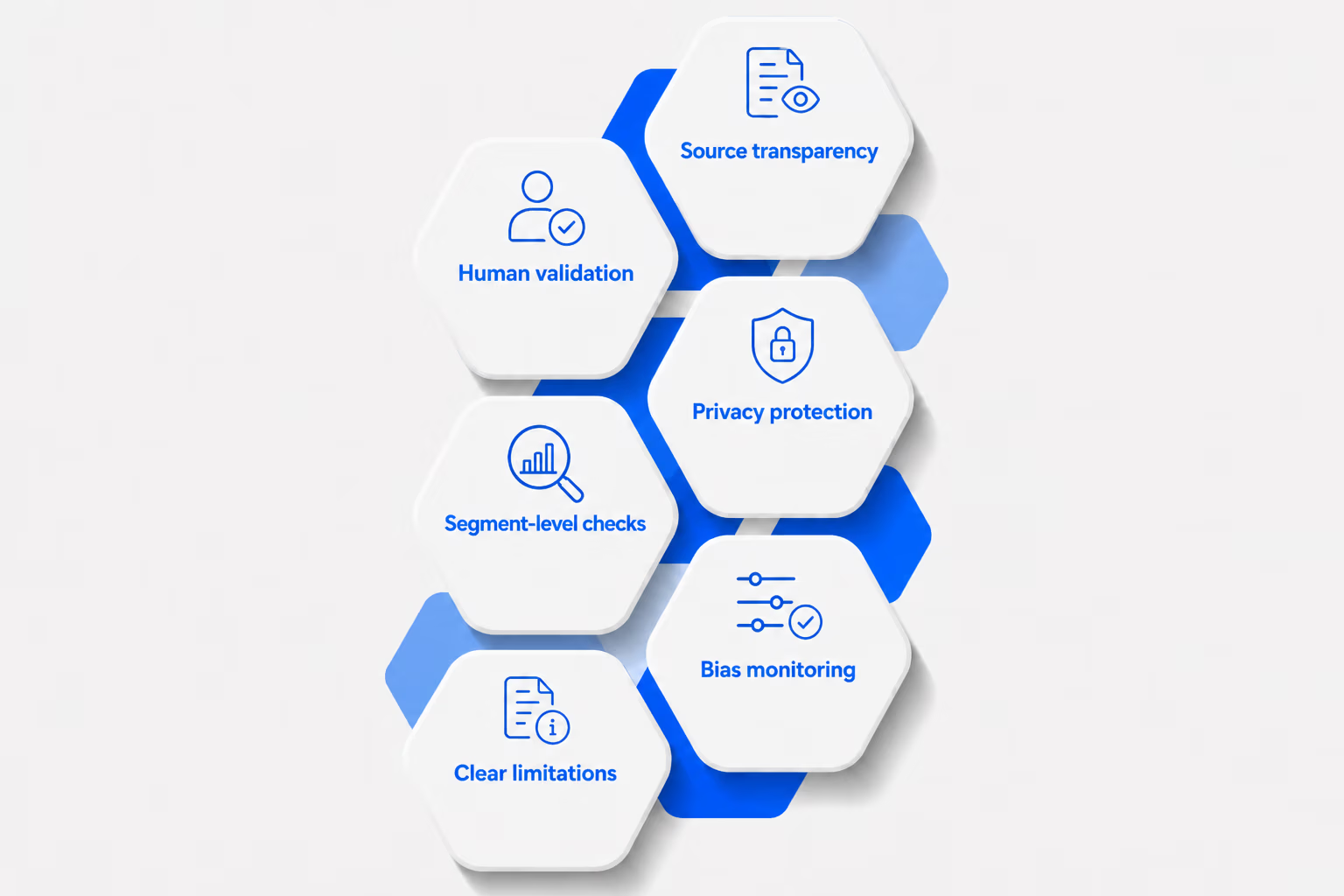
Strong guardrails include:
- Source transparency: Every insight should be traceable to real data, not unsupported AI summary.
- Human validation: Researchers should review outputs for misclassification, cultural errors, and exaggerated conclusions.
- Privacy protection: Customer data, healthcare feedback, financial information, and support logs need careful handling.
- Segment-level checks: UAE results should separate relevant audiences instead of blending tourists, residents, nationals, and expats.
- Bias monitoring: AI models should be checked for language, demographic, and sentiment bias.
- Clear limitations: Teams should state what the data can and cannot prove.
AI can detect patterns, but it cannot automatically understand business context. Guardrails protect research credibility.
How AI Fits Into Research Workflows
A strong AI-supported workflow usually follows five steps.
1. Define the business question clearly. AI should not analyze everything blindly.
2. Gather the right data sources. This may include surveys, reviews, interviews, social data, customer logs, and complaint channels.
3. Clean and structure the data. Duplicates, spam, irrelevant posts, and poor-quality responses must be removed.
4. Use AI to detect themes, sentiment, patterns, and anomalies.
5. Apply human interpretation. Researchers validate meaning, compare segments, and translate findings into decisions.
This is the difference between automation and intelligence. Automation makes tasks faster. Intelligence makes decisions clearer.
Where BioBrain Insights Fits Subtly Into This Shift
Modern UAE insights teams are increasingly looking for systems that connect primary research, open-ended analysis, web intelligence, and expert validation in one workflow. This is where platforms such as BioBrain Insights are relevant as part of the broader shift toward AI-supported, human-validated research.
The value is not simply that AI can summarize data faster. The value is that research teams can connect survey responses, qualitative inputs, digital signals, and consumer sentiment more clearly - without losing the discipline of expert review.
Final Thoughts
AI market research in the UAE is becoming less about automation alone and more about consumer intelligence. Retailers need faster reading of shopper friction. CX teams need early warning signals. Healthcare brands need careful interpretation of patient feedback. Financial firms need to understand trust, security, and onboarding barriers. Social listening teams need to separate real consumer signals from digital noise.
The future belongs to insight teams that combine AI speed with human judgment, clean data, transparent methods, and local context.
For brands building this capability, platforms such as BioBrain Insights represent where the market is heading- AI-assisted research that helps teams read consumer signals faster, validate them more carefully, and turn scattered feedback into clearer decisions.


.avif)