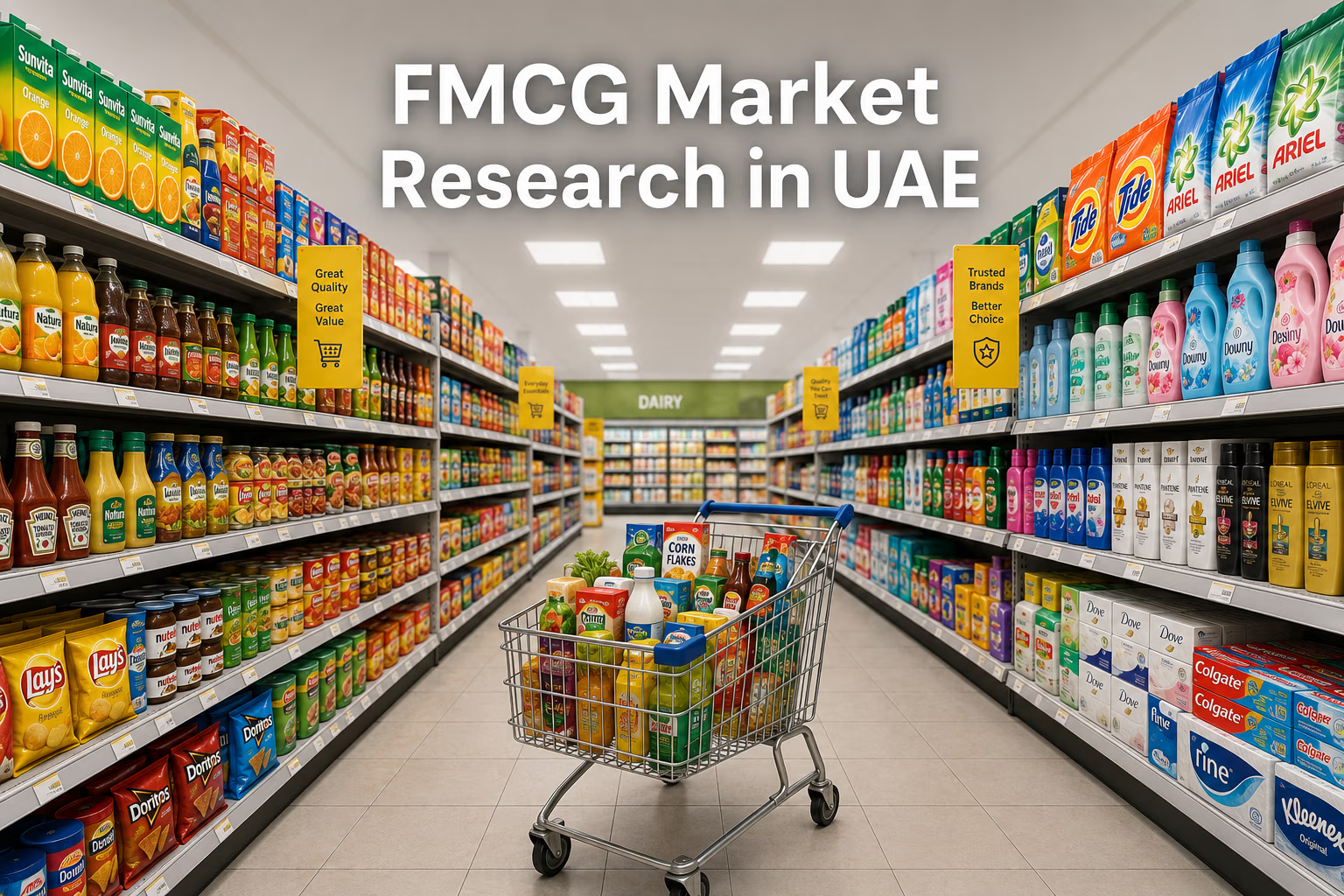
The UAE is one of the most exciting FMCG markets in the world because nothing here stays still for long.
A new snack format can trend across Dubai in weeks. A beverage brand can gain traction through quick-commerce visibility before it becomes visible on a physical shelf. A household care product can win loyalty in one community and remain unnoticed in another. A premium food brand can look aspirational in one retail environment and overpriced in another.
That is the real challenge of fast-moving categories in the UAE. Products move quickly, but shopper expectations move even faster.
For FMCG brands, the UAE is not just a place to launch. It is a place to listen carefully, test sharply, and understand how different consumer groups make everyday choices. This is why FMCG market research UAE has become more important than ever. The market is modern, multicultural, digitally active, and highly competitive. Winning here requires more than distribution. It requires shopper intelligence.
The strongest FMCG company today is not the one with the widest shelf space alone. It is the one that understands why shoppers pick, compare, switch, repeat, and recommend.
The UAE FMCG Market Is Growing, But the Growth Is More Complex
The UAE’s FMCG sector is showing clear momentum. In 2025, the market reportedly grew by 6.8% in value, supported by 4.9% growth in consumption volume and 2% unit value growth. That is an important signal. It shows that growth is not only price-led. People are buying more, but they are also becoming more selective about what feels worth buying.
For brands, this changes the meaning of opportunity.
Growth does not automatically mean every product will perform well. It means more shoppers are active, more baskets are being built, and more category decisions are happening every day. But it also means more competition for attention, more pressure on pricing, and more need to understand the buying moment.
An FMCG company entering or expanding in the UAE must look beyond top-line demand. The deeper question is: what kind of growth is happening?
Is it driven by family consumption? Is it linked to premium products? Is it coming from online grocery? Is it shaped by promotions? Is it being influenced by health, convenience, or culture?
That is where FMCG consumer insights GCC become especially valuable. The GCC region has strong consumption potential, but the UAE has its own rhythm. Dubai and Abu Dhabi behave differently from smaller Emirates. Hypermarket shoppers behave differently from quick-commerce users. Premium buyers behave differently from value-led households.
A single market view is not enough anymore.
Market Signals Brands Should Track
One Market, Many Shopper Worlds
The UAE shopper cannot be understood through one profile.
A shopper in Dubai Marina may be looking for convenience, clean labels, and premium packaging. A family in Sharjah may be comparing value packs across supermarkets. A tourist in Downtown Dubai may buy on impulse. A South Asian household may look for familiar flavors and trusted price points. A young professional may prefer smaller packs because space, routine, and lifestyle demand flexibility.
This is why shopper behavior UAE is so layered.
The country’s population mix creates a rare FMCG environment. There are Emirati households, Arab expats, South Asian families, Filipino consumers, Western professionals, African communities, tourists, and business travelers. Each group brings different food habits, brand references, beauty standards, health concerns, fragrance preferences, shopping channels, and price expectations.
For FMCG companies Dubai, this is both a growth engine and a research challenge.
A product claim that works beautifully for one group may feel irrelevant to another. “Family value” may drive one purchase, while “imported quality” drives another. “Low sugar” may attract health-conscious buyers, while “authentic taste” may matter more in food categories. “Long-lasting freshness” may work in personal care, while “safe for children” may matter more in home care.
This is why modern FMCG research cannot rely only on demographics. It needs to study moments.
Breakfast moments. School lunch moments. Office snacking moments. Ramadan stocking moments. Weekend family shopping moments. Quick delivery moments. Bulk-buying moments. Gifting moments. Fitness-led consumption moments.
Fast-moving categories grow when brands understand the occasion behind the basket.
The Digital Shelf Is Now a Real Shelf
For years, FMCG brands focused heavily on physical retail execution: shelf placement, aisle visibility, promotion displays, pack blocking, and in-store offers. These still matter. But in the UAE, the digital shelf is now just as important.
The online grocery market in the UAE was valued at around USD 4.13 billion in 2025 and is projected to grow strongly through 2034. Quick commerce is also becoming a serious influence, with the UAE expected to account for more than 40% of MENA’s quick-commerce market by 2025.
This changes the shopper journey.
A consumer may see a product in a supermarket, compare it online, read reviews, and reorder it through an app. Another may discover a brand on a delivery platform without ever noticing it in-store. A shopper may search for “healthy snacks,” “baby wipes,” “protein drink,” “dishwashing liquid,” or “low sugar juice” and choose from the first few visible options.
In this environment, FMCG visibility is no longer only about shelf height. It is also about search ranking, product images, reviews, delivery speed, pricing, bundle logic, ratings, and digital availability.
A brand can lose not because the product is weak, but because the digital shelf is not optimized.
This is where always-on research becomes powerful. Brands need to understand not only what shoppers say, but what they see when they search. They need to connect survey feedback, product reviews, digital shelf audits, category movement, and open-ended consumer language into one clearer view.
For fast-moving categories, fragmented insight creates slow decisions. Connected insight creates sharper action.
Physical Shelf vs Digital Shelf
Premiumization Is Rising, But Value Still Decides
The UAE is often seen as a premium market, and that is partly true. Shoppers are open to better-quality products, imported ranges, health-led claims, specialty categories, and elevated packaging. But premiumization in FMCG is not simple.
Premium does not always mean expensive. It means justified.
A consumer may pay more for organic ingredients, but only if the brand feels credible. A shopper may choose a premium detergent, but only if performance is visible. A parent may pay more for baby care, but only if safety and trust are clear. A beverage buyer may choose a healthier option, but not if the taste feels compromised.
In UAE, value and premium often sit together. Shoppers may buy premium coffee but compare prices on household cleaners. They may spend more on skincare but look for bundles in snacks. They may choose imported products for certain occasions and local or regional brands for everyday use.
This makes FMCG market research UAE essential for understanding the trade-off.
The question is not whether consumers want premium products. The question is where they are willing to trade up, where they expect savings, and what proof they need before paying more.
For FMCG brands, the most dangerous assumption is believing that premium packaging alone creates premium perception. In many categories, shoppers are becoming more informed. They look at ingredients, origin, claims, reviews, and performance. The brand story must hold up at the shelf, on the app, and after usage.
Health, Convenience and Culture Are Reshaping Categories
Three forces are reshaping FMCG choices in the UAE: health, convenience, and culture.
Health is becoming more visible across everyday categories. Shoppers are looking at sugar, protein, calories, natural ingredients, dermatological claims, baby-safe formulations, and wellness cues. This is especially important in beverages, snacks, dairy, personal care, and family-focused categories.
Convenience is equally powerful. UAE shoppers live busy, mobile, urban lives. Quick delivery, easy storage, ready-to-use formats, resealable packs, single-serve portions, and app-based reordering all influence buying behavior.
Culture adds another layer. Taste preferences, fragrance expectations, halal suitability, Ramadan consumption, family rituals, gifting behavior, and community-specific habits can all shape category performance.
This is where FMCG consumer insights GCC need to go deeper than trend headlines. Every brand knows that health and convenience matter. Fewer brands know how these ideas behave inside a specific category, price point, community, or channel.
A “healthy” snack can mean low sugar for one consumer, high protein for another, natural ingredients for another, and portion control for someone else. “Convenient” can mean fast delivery, easy preparation, smaller packs, longer shelf life, or fewer decision steps.
The words may be common. The meanings are not.
Promotions Can Create Growth, But They Can Also Hide Weakness
Promotions are a major part of FMCG retail in the UAE. Discounts, bundles, loyalty points, app deals, seasonal offers, and multi-buy packs can drive quick movement. For a fast-moving category, that can look like success.
But promotional growth can be misleading.
A sales spike may show that shoppers liked the price, not necessarily the product. A bundle may create pantry loading, not brand loyalty. A first-time trial may not translate into repeat purchase. A discount may bring attention but weaken premium perception if used too often.
This is why promotion research should go beyond campaign performance. Brands need to understand the quality of the demand they are creating.
Did the promotion bring in new buyers? Did it attract the right segment? Did it increase repeat? Did it shift brand perception? Did shoppers remember the product or only the offer?
In the UAE, where retail competition is intense and shoppers have many alternatives, brands cannot afford to mistake temporary movement for meaningful momentum.
The best FMCG research connects promotion response with shopper motivation. It looks at what happened before the sale, during the offer, and after the discount disappeared.
Fast-Moving Category Research Priorities in the UAE
Why Research Speed Matters in Fast-Moving Categories
FMCG decisions happen quickly. A shopper does not usually spend weeks deciding between two shampoos, juices, biscuits, detergents, or ready-to-cook meals. The decision is often made in seconds, shaped by habit, price, visibility, memory, and immediate need.
That means slow insight cycles can cost brands real opportunities.
By the time a traditional research cycle is complete, a competitor may have launched a new pack, a promotion may have ended, a seasonal window may have passed, or online reviews may have already shaped perception.
This is why many FMCG teams now need faster, more connected research systems. Not research that is rushed, but research that is built to capture signals while they still matter.
For example, open-ended consumer responses can reveal why a claim is not landing. Digital shelf checks can show whether competitors are winning on visibility. Real-time quality checks can protect data from poor responses. Quick-turn surveys can test pack, price, claim, or usage barriers before a larger campaign goes live.
Speed alone is not enough. The insight must also be reliable, structured, and decision-ready. That is where AI-enabled research workflows, verified respondents, automated quality checks, and expert-led analysis can help FMCG brands reduce guesswork without slowing down the business.
The Future of FMCG Research in the UAE
The future of FMCG in the UAE will not be decided only by who launches more products. It will be decided by who learns faster from the market.
The next wave of shopper insight will be more connected across channels. Brands will need to combine surveys, retail data, digital shelf signals, social listening, product reviews, open-text feedback, and campaign performance. Each signal shows one part of the story. The real value comes when those signals are connected.
For UAE and GCC-focused FMCG brands, this is especially important because the market is highly dynamic. A product can perform differently across Emirates, nationalities, income groups, family sizes, shopping missions, and digital platforms.
A brand may have strong awareness but weak conversion. Another may have strong trial but weak repeat. Another may perform well offline but disappear online. Another may win in one community and fail to resonate with another.
Traditional category research can identify some of these patterns. But the next advantage will come from research that is faster, more granular, and more directly linked to shopper decisions.
That is what makes shopper insight the new growth engine for fast-moving categories.
Final Thoughts
The UAE FMCG market is full of opportunity, but it is not a market where broad assumptions survive for long. Shoppers are diverse, channels are changing, digital grocery is expanding, and competition is intense across almost every fast-moving category.
For FMCG companies, the real question is no longer whether the UAE is a growth market. It clearly is. The sharper question is whether brands understand the shopper well enough to grow with precision.
FMCG market research in UAE helps uncover the hidden signals behind everyday buying: why shoppers choose, why they compare, why they switch, and why they come back. In a market shaped by 200+ nationalities, rising online grocery, premium expectations, and quick-changing retail behavior, those signals can become the difference between being available and being chosen.
For brands that want to turn complex shopper behavior into clearer market action, BioBrain Insights helps connect speed, data quality, AI-enabled analysis, and expert market research thinking into decision-ready insights built for fast-moving categories.