Key Points
The Youth Engine: Nearly half (50%) of the UAE’s total population is concentrated between the ages of 15 and 35.
A staggering 66% of Saudi consumers actively use Generative AI tools in 2026.
Saudi Arabia’s e-commerce market alone is estimated at $31.29 billion in 2026 and is pacing toward $54.87 billion by 2031 at an 11.92% CAGR
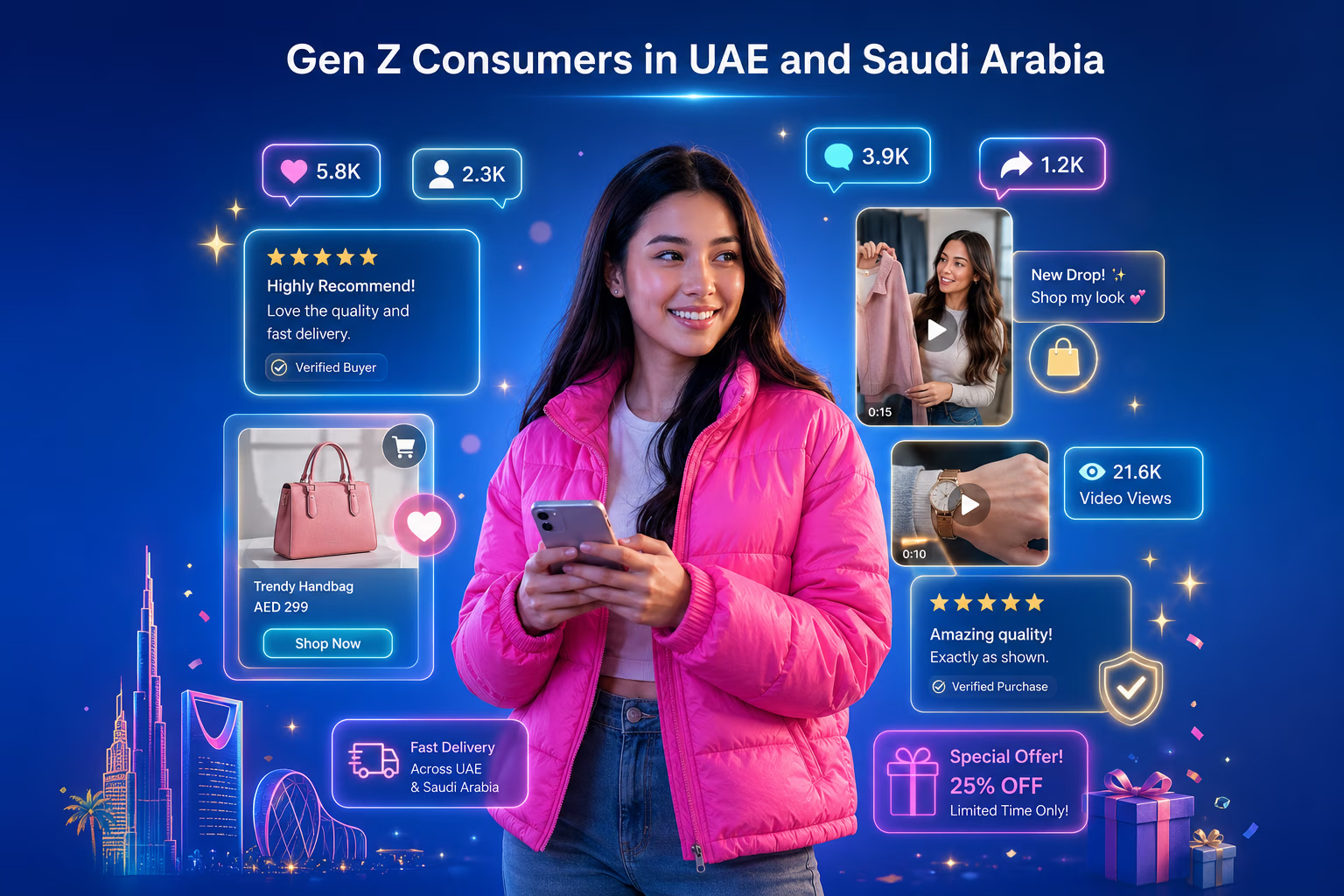
Gen Z in the Gulf is not just “young consumers with phones.” They are the generation turning discovery into conversation, shopping into content, and trust into a public decision. In the UAE and Saudi Arabia, they are shaping how brands are found, questioned, compared, purchased, and sometimes rejected within minutes.
For market researchers, this means one thing clearly: studying Gen Z requires more than a demographic filter. It requires understanding how this generation moves through culture, mobile journeys, social proof, payments, creator influence, and open-ended digital expression.
The data is already shifting the research brief.
In the UAE, 67% of consumers used a phone as part of their latest retail purchase, and 53% want cross-channel shopping experiences, according to the 2025 Global Digital Shopping Index UAE edition. The same report found that 32% of UAE shoppers used biometric authentication for their latest online transaction, showing how mobile shopping and trust infrastructure are becoming connected.
In Saudi Arabia, the signal is different but equally powerful. More than 70% of Saudi citizens are under 35, according to a 2024 GASTAT family statistics report cited in regional coverage. That makes youth behavior central to the Kingdom’s consumer future, not a side segment.
This is why research on gen z consumers UAE and gen z shopping Saudi Arabia should focus less on “what do they like?” and more on “what creates confidence?”
1. Discovery Starts Inside Social Proof
Gen Z does not always begin with a search engine or a brand website. Discovery often starts inside culture: a creator video, a TikTok comment thread, a Snapchat story, a WhatsApp recommendation, a marketplace review, or a friend’s screenshot.
This makes social commerce GCC more than a buying channel. It is a trust environment.
A young consumer may see a product on Instagram, check comments, search for real customer photos, compare prices, ask a friend, and then decide whether the brand feels safe enough to try. The journey is short, but not simple.
For researchers, the key question is not only “Where did you hear about this brand?” It is:
- What made you stop scrolling?
- Which proof point made the product feel real?
- Did comments strengthen or weaken trust?
- Did you search the brand after seeing it socially?
- What nearly stopped you from buying?
This is especially important because Gen Z often trusts signals that are messy but human: screenshots, comments, customer videos, unfiltered reviews, and creator honesty.
2. Loyalty Is Conditional, Not Dead
Gen Z is often described as disloyal. That is too easy.
A more useful insight is that Gen Z loyalty is conditional. They stay when a brand remains useful, honest, fast, relevant, and consistent. They leave when the experience feels careless.
For digital consumers UAE, loyalty may depend on mobile convenience, fast delivery, clear returns, secure checkout, and responsive support. A brand may look premium, but if the app is slow or the refund process is unclear, the experience feels broken.
In Saudi Arabia, loyalty can also be shaped by local relevance. A brand that understands Arabic communication, cultural tone, family context, and creator fit may earn more trust than a global campaign that feels imported.
Researchers should replace broad loyalty questions with sharper ones:
- What would make you buy again?
- What would make you stop buying instantly?
- What would you forgive once, but not twice?
- What makes a brand feel fake?
- What makes a brand worth recommending publicly?
These questions produce better insight because Gen Z explains loyalty through experiences, not brand theory.
3. Mobile Is the Real Marketplace

For Gen Z, mobile is not one channel. It is the store, wallet, review engine, search tool, customer service desk, and complaint platform.
That is why mobile commerce GCC research must study friction minute by minute.
A weak product page, hidden delivery fee, confusing Arabic translation, slow checkout, limited payment option, or unclear return policy can end the journey before the brand gets a second chance.
The UAE data makes this especially clear. When two-thirds of recent retail purchases involve a phone, mobile behavior is not “digital support.” It is retail behavior itself.
Researchers should use methods that capture real mobile behavior, such as:
- mobile diary studies,
- app journey testing,
- cart abandonment interviews,
- screen-recorded shopping tasks,
- WhatsApp support audits,
- and review mining.
The goal is to find the exact moment when interest becomes hesitation.
4. Trust Is Built Through Small Signals
Gen Z trust is rarely created by a single ad. It is built through many small signals.
A young shopper may trust a brand because:
- reviews sound specific,
- creators disclose honestly,
- real customers show the product,
- delivery timelines are clear,
- payment feels secure,
- support replies quickly,
This is where UAE and Saudi Arabia need different research lenses.
In the UAE, audience diversity matters. Researchers must separate Emirati youth, Arab expats, South Asian expats, Western expats, tourists, and long-term residents where relevant. A single Gen Z sample can easily hide very different buying logic.
In Saudi Arabia, local context matters strongly. City, gender, language, family influence, creator trust, and local cultural tone can affect whether a brand feels relevant or distant.
The same generation may use similar apps, but they may not trust brands for the same reasons.
5. Open-Ended Responses Are Where the Real Gold Is
Gen Z often gives the most useful insights when they are not forced into fixed answer options.
Open-ended responses reveal the language of trust, rejection, excitement, doubt, and value. Words like “overhyped,” “worth it,” “fake,” “clean,” “slow,” “too much,” “looks real,” or “not for me” can tell researchers more than a neat rating scale.
For Gen Z research, open-ended analysis should look for:
- rejection triggers,
- creator credibility,
- price anxiety,
- delivery pain points,
- authenticity cues,
AI can help organize large volumes of open text, but human interpretation remains essential. Gen Z language can include slang, sarcasm, emojis, Arabic-English mixing, cultural references, and platform-specific expressions that automated tools may misread.
This is where researchers need both speed and judgment.
6. UAE and Saudi Gen Z Should Not Be Studied the Same Way
The UAE and Saudi Arabia are both digitally advanced markets, but Gen Z behavior is shaped by different environments.
In the UAE, the research challenge is fragmentation. A Gen Z sample may include nationals, expats, tourists, students, young professionals, high-income residents, and value-conscious workers. Language and lifestyle segmentation matter as much as age.
In Saudi Arabia, the research challenge is transformation. Youth influence is tied to changing entertainment, retail, digital payments, fashion, food, gaming, and local identity. The market is not only young; it is actively redefining what modern Saudi consumption looks like.
So the same questionnaire should not be copied across both markets.
For UAE Gen Z, researchers should prioritize:
- nationality and residence segmentation,
- language preference,
- mobile shopping journey,
- expat versus national behavior,
- tourist influence where relevant,
For Saudi Gen Z, researchers should prioritize:
- city-level differences,
- creator trust,
- Arabic content tone,
- family and peer influence,
- digital payment confidence,
- entertainment-linked spending,
7. What Researchers Should Track Next
The best Gen Z tracking systems connect behavior, trust, and language.
A practical framework should include:
- Discovery signals:
Creators, peers, search, comments, marketplaces, short-form video, and reviews. - Mobile friction:
Checkout steps, delivery clarity, payment confidence, page speed, language, support, and return policies. - Trust markers:
Real reviews, creator honesty, brand replies, customer content, transparent pricing, and complaint handling. - Loyalty triggers:
Quality, speed, relevance, rewards, identity, convenience, and consistent service. - Open-ended sentiment:
The exact words young consumers use to explain why they bought, hesitated, switched, or rejected a brand.
This gives market researchers a more realistic picture of Gen Z as a behavior system, not just an age band.
Final Thoughts
In the UAE and Saudi Arabia, Gen Z is not just a future audience - they are already exposing where consumer expectations are heading next. Their choices are shaped by mobile journeys, social proof, creator trust, open-ended conversations, and quick shifts in sentiment. For market researchers, the real opportunity is to connect these scattered signals into clear intelligence.
This is where modern insight approaches, including platforms like BioBrain Insights, are becoming relevant - not as a replacement for research expertise, but as a way to read Gen Z signals faster, validate them better, and understand what young consumers are likely to expect next.


.avif)