Market research is under pressure. Budgets are tightening, expectations are rising, and the conversation is shifting toward a more fundamental question:
where is ROI actually created within market research itself?
For years, research has been treated as an output-driven function - delivering insights, reports, and recommendations. But today, the focus is no longer just on proving value after the fact. It is about building ROI directly into how research is designed and executed.
This shift is already underway across organizations, where research is moving closer to decision-making systems and operational accountability. The emphasis is not just on delivering insights, but on ensuring that every stage of the research process contributes to measurable impact.
The challenge, however, is structural. Most research workflows were not built with ROI in mind. As a result, value is often lost within execution itself - long before insights reach decision-makers.
The ROI Problem: Why Market Research Struggles to Generate Measurable Impact
The core issue is not just perception - it is where value is (and isn’t) created within the research process. Market research is still widely treated as a reporting function rather than a system designed to generate measurable outcomes. This creates a structural gap:
- Insights are generated, but not operationalized
- Data is processed, but not structured for decision-making
- Outputs are delivered, but not embedded into workflows
Under tighter budgets, this inefficiency becomes more visible. The pressure is not just to justify spend, but to ensure that every stage of research execution contributes to ROI.
This requires a shift from asking “What ROI did research deliver?” to “Where is ROI being created- or lost- within the research process?” Without this shift, even high-quality research struggles to create measurable impact - not because the insights lack value, but because the system producing them is not optimized for ROI.
Why AI Alone Does Not Solve the ROI Problem
The introduction of AI into market research has created both optimism and confusion.
On one hand, AI has dramatically improved speed:
- Transcript summarization
- First-pass theme clustering
- Survey drafting
- Data exploration
In fact, across practitioner discussions, researchers consistently point out that AI removes the “blank page problem” and accelerates early-stage work.
Across multiple Reddit discussions, users consistently supported this view:
“AI speeds up the messy middle… but you still have to sense check everything. It helps you move faster, but it doesn’t decide what matters.”
This captures the reality perfectly.
Because speed does not equal ROI.
AI-generated outputs are often:
- Plausible
- Well-structured
- Logically grouped
But they are not:
- Context-aware
- Business-aligned
- Strategically validated
This is where things start to break.
In real-world analytics, the hardest problems are:
- Determining whether data is trustworthy
- Distinguishing correlation from causation
- Identifying what actually drives decisions
And this is where AI still falls short.
Large language models simulate analysis- but they don’t truly understand your data or your business context.
The Hidden ROI Killer: Data Quality
Before execution, before analysis, before AI- there is a more fundamental issue:
Data quality
The market research ecosystem is facing a growing credibility challenge:
- The industry is losing $350+ million annually to survey fraud
- AI-generated responses are becoming increasingly indistinguishable from real ones
- Synthetic data shows only ~60% consistency across formats
- Many systems operate as black boxes with limited transparency
This creates a dangerous scenario.
You think you’re analyzing real consumer behavior- but you may actually be analyzing:
- Low-quality responses
- Automated inputs
- Synthetic approximations
The business consequences are real:
- Products are launched based on false signals
- Features are built for problems that don’t exist
- Strategic decisions are made on unreliable data
Bad data doesn’t just reduce ROI- it actively destroys it.
The Real Bottleneck: The “Messy Middle” of Market Research
Most conversations around ROI focus on:
- Data collection
- Final reporting
But the real leverage lies elsewhere.
The highest ROI gains in modern research come from optimizing what practitioners call the “messy middle”:
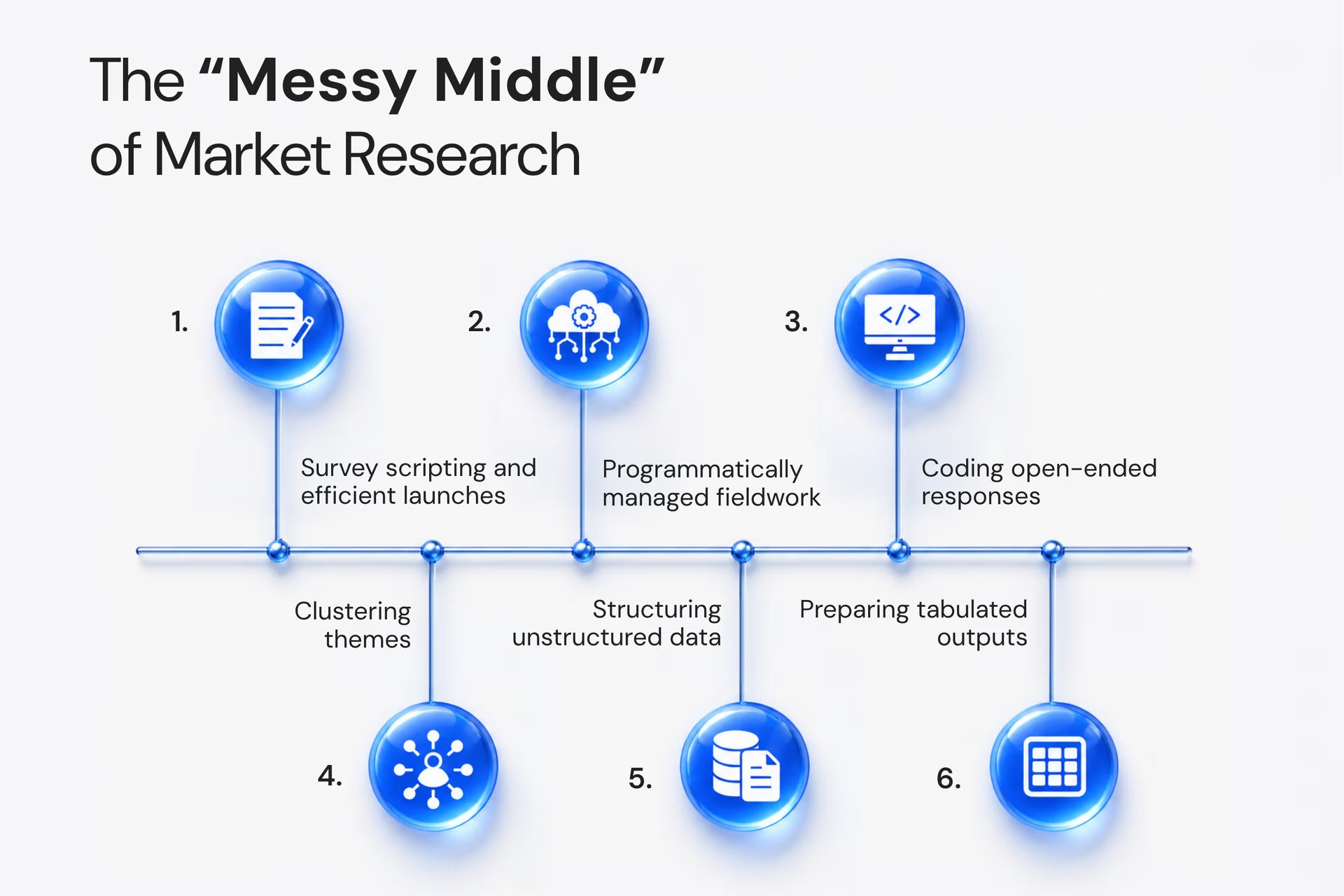
- Survey scripting and efficient launches
- Programmatically managed fieldwork
- Coding open-ended responses
- Clustering themes
- Structuring unstructured data
- Preparing tabulated outputs
This is where execution shifts from manual effort to intelligent systems.
And this is where AI actually adds value - not by replacing researchers, but by removing repetitive workload.
Data Engineering as the Core Driver of ROI
This is the most important shift- and the most overlooked one.
At the center of intelligence-led execution is one capability:
Data Engineering for Market Research
Not generic data engineering.
Research-specific data engineering.
This is where ROI is truly created.
Open-End → Closed-End Conversion
Open-ended responses are rich- but operationally weak.
Without structure:
- They cannot be tabulated
- They cannot be compared across segments
- They cannot support statistical analysis
With structured transformation:
- Themes become quantifiable
- Frequency becomes measurable
- Cross-tabs become possible
- Patterns become statistically valid
This unlocks:
- Segment-level analysis
- Correlation modeling
- Decision simulation
- ROI attribution
Let’s be clear:
The real source of ROI is not speed in analyzing open-ended data.
It is how effectively that data is structured, transformed, and made usable within the research workflow itself.
ROI is created when unstructured inputs are converted into numerically usable, decision-ready intelligence - not at the point of analysis, but within execution.
This is where most research workflows still break.
And this is where intelligence-led systems fundamentally outperform traditional approaches.
The Shift: From AI-Led to Intelligence-Led Research
The industry is currently over-focused on AI adoption.
But ROI is not driven by AI usage.
It is driven by execution design.
AI-Led Execution:
- Faster outputs
- Automated summaries
- Surface-level efficiency
Intelligence-Led Execution:
- Structured data pipelines
- Programmatically managed workflows
- Validated transformations
- Traceable analysis
- Context-aware synthesis
- Statistically grounded outputs
The difference is fundamental.
AI accelerates tasks.
Engineered intelligence systems drive outcomes - with precision and efficiency.
How to Actually Demonstrate ROI in Market Research
ROI in market research cannot be assumed. It must be engineered.
The focus is not on measuring impact after research is completed, but on ensuring that value is created at every stage of execution. This requires a shift toward structured, intelligence-led workflows where outcomes are engineered, not inferred.
Key approaches include:
- Structuring data for decision-making, not just analysis
- Connecting research outputs directly to business workflows
- Designing studies with clear decision-use cases from the start
- Translating insights into measurable variables, not just narratives
- Building traceability between inputs, transformations, and outputs
Critically, ROI is not created at the point of reporting - it is built before and during execution.
For example, a pricing study does not create value simply by identifying a potential 5% increase opportunity. ROI is realized only when that insight is derived from structured, validated data, translated into decision-ready outputs, and embedded into execution systems.
This is why the industry must move beyond one-time research projects toward continuous intelligence systems, where data flows, transformations, and outputs are consistently aligned with decision-making needs.
Final Perspective
Market research is not constrained by a lack of tools. It is constrained by how those tools are applied within fragmented execution models.
ROI is lost when:
- Data is unreliable or unstructured
- Execution remains manual and disconnected
- Outputs are not designed for decision integration
AI is improving speed. But speed alone does not create ROI.
ROI in market research is created when speed is combined with:
- structured data pipelines
- validated transformations
- context-aware analysis
- decision-ready outputs
Closing Thought
The future of market research ROI will not be defined by how quickly insights are generated, but by how effectively value is engineered into the research process itself.
ROI will belong to systems where data is structured, workflows are intelligent, and every output is designed to drive real decisions - not just deliver information.