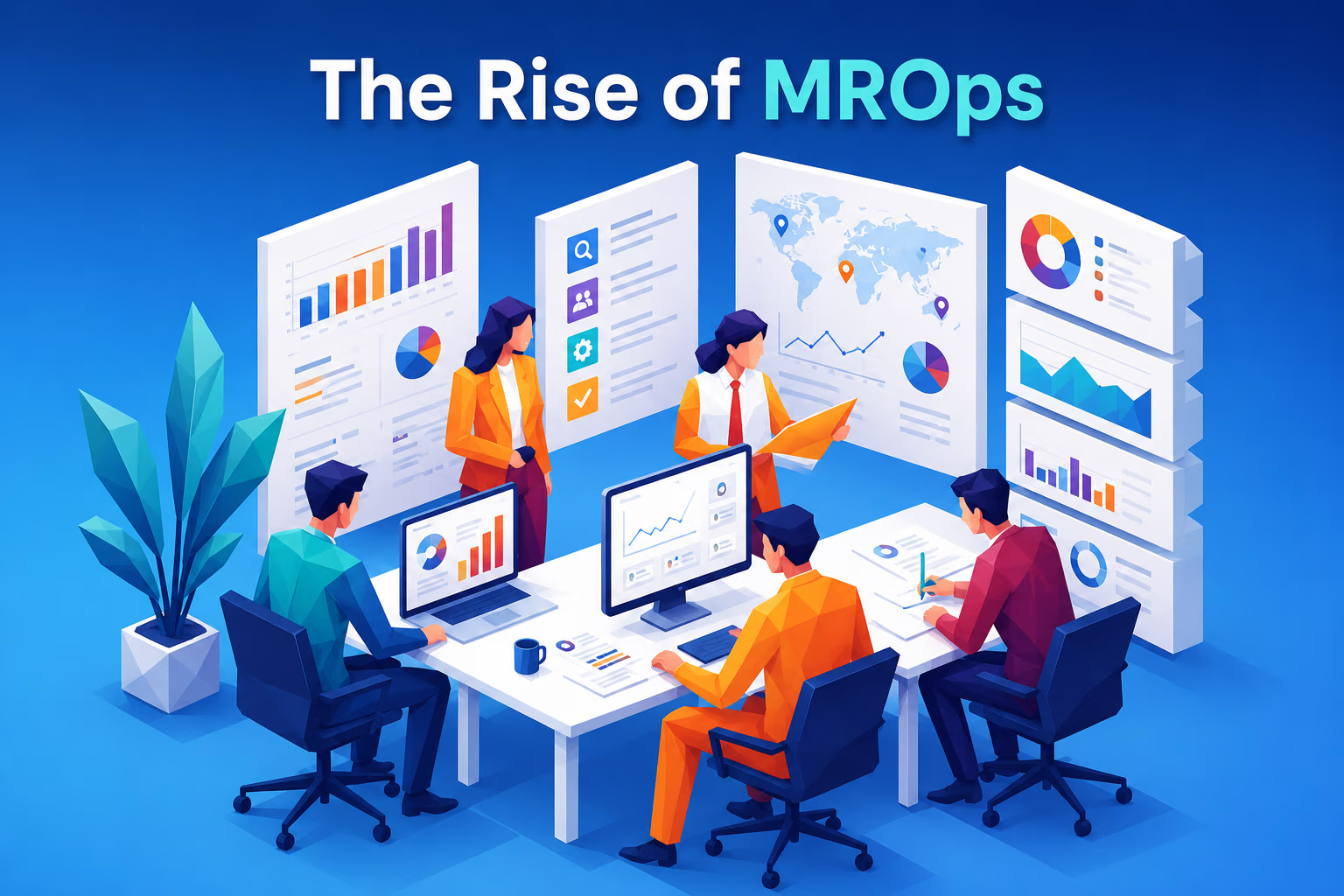
Market research GCC teams are entering a new operating era. The work is no longer only about designing questionnaires, collecting responses, building charts, and presenting findings. It is now about running research like a high-performance system: faster, cleaner, more connected, more accountable, and more scalable.
That shift is driving the rise of MROps.
MROps, or Market Research Operations, refers to the operational layer that manages how research is planned, automated, governed, executed, validated, analyzed, and delivered. It brings structure to the full research lifecycle, from brief to questionnaire, sample, fieldwork, data quality, dashboards, reports, knowledge storage, and decision follow-through.
In the GCC, this matters because research demand is rising across fast-moving sectors: retail, FMCG, banking, tourism, healthcare, real estate, entertainment, technology, and public services. Teams are being asked to deliver more insight, across more markets, with faster turnaround and higher quality. Traditional project-by-project research workflows are starting to feel too slow.
MROps UAE and wider GCC research operations are emerging because insight teams need a better way to manage speed without losing trust.
Research Teams Are Becoming Operating Systems
The old model treated each study as a separate project. A brief came in, a survey was built, fieldwork ran, data was cleaned, charts were created, and the report was delivered. Then the next project started.
That model still works for some studies, but it struggles when organizations need continuous intelligence.
Today, teams need to track consumer behavior, customer satisfaction, brand health, product testing, campaign response, pricing sensitivity, and digital sentiment almost continuously. They need clean data, version control, consistent methods, repeatable workflows, supplier visibility, automated reporting, and faster decision loops.
MROps turns research from a series of one-off projects into a repeatable operating system. It defines who does what, which tools are used, where data lives, how quality is checked, how dashboards are updated, and how insights are reused.
This is especially important for GCC businesses operating across the UAE, Saudi Arabia, Qatar, Kuwait, Bahrain, and Oman. Each market has different consumers, languages, regulations, and channels. Without operational discipline, research can quickly become fragmented.
Why MROps Is Rising in GCC Research Teams
Why GCC Market Research Needs Stronger Operations
The GCC is digitally mature and commercially dynamic. The UAE had 11.1 million internet users in early 2025, with 99% penetration. Saudi Arabia had 34.4 million internet users by the end of 2025, also at 99% penetration. These numbers make online research, digital feedback, social listening, and automated data collection highly relevant.
But digital scale creates operational pressure.
More data does not automatically mean better insight. It can also create more duplication, more noise, more inconsistent methods, and more time spent fixing messy outputs. A team may run multiple surveys across markets, but if question wording differs, sample quality varies, or reporting formats are inconsistent, comparison becomes difficult.
MROps helps solve this by creating the infrastructure behind reliable research. It standardizes templates, approval flows, data quality rules, translation processes, survey logic checks, vendor management, dashboard formats, and reporting standards.
For market research GCC teams, this is not bureaucracy. It is speed with control.
From Manual Coordination to Research Automation GCC
Research automation GCC is one of the biggest reasons MROps is becoming more important. Automation can help with questionnaire scripting, logic testing, sample monitoring, respondent validation, open-ended coding, charting, tabulation, dashboarding, and first-draft reporting.
But automation without operations can create chaos.
If every team uses different tools, different naming conventions, different sample checks, and different reporting structures, automation may simply make poor workflows faster. MROps ensures automation is applied in the right places, with the right controls.
A strong research operations model asks:
- Which tasks should be automated?
- Which tasks need human review?
- How is data quality checked?
- Who approves questionnaire changes?
- How are survey versions tracked?
- Where do raw data and cleaned data live?
- How are insights archived for future reuse?
Automation is the engine. MROps is the control system.
Manual Research Workflow vs MROps Workflow
Data Quality Is Becoming an Operations Problem
Data quality has always mattered in research, but the online research environment has made it more operationally complex. Market research teams now need to detect speeders, duplicate respondents, straightliners, suspicious IPs, bot-like behavior, inconsistent answers, AI-generated open ends, and supplier-level quality issues.
This cannot be left until the end of a project.
If low-quality responses are detected only after fieldwork closes, the team loses time, budget, and confidence. MROps brings quality checks into the workflow itself. It defines thresholds, review rules, escalation steps, supplier scorecards, and replacement processes.
In GCC research, this is especially relevant because studies often span multiple countries, languages, demographics, and sample sources. A quality issue in one market can distort the full regional picture.
MROps helps teams move from reactive cleaning to proactive quality management.
MROps UAE: Why the UAE Is a Natural Testbed
MROps UAE is gaining relevance because the UAE is a highly digital, multilingual, service-led, and insight-hungry market. Businesses operate across retail, luxury, tourism, healthcare, finance, real estate, and government services, often serving both local and international audiences.
This creates heavy demand for fast, reliable research.
A UAE research team may need to understand Emirati consumers, Arab expatriates, South Asian residents, tourists, business travelers, premium shoppers, banking users, and healthcare patients. Each audience may require different language choices, cultural context, sampling strategy, and reporting lens.
The UAE’s wider digital direction also supports operational maturity. Abu Dhabi’s 2025–2027 digital strategy aims for 100% adoption of sovereign cloud for government operations and automation of 100% of processes. While that is a public-sector strategy, it reflects a wider regional expectation: processes should be digital, integrated, secure, and measurable.
Research operations are moving in the same direction.
AI Is Raising the Bar for Research Governance
AI is changing market research, but it also creates new governance needs. Saudi business AI adoption reached 33.1% in 2025, showing that AI is moving into real business operations across the region. For research teams, AI can accelerate survey analysis, open-ended coding, summarization, segmentation, and reporting.
But AI also raises questions.
- Can the model understand Arabic dialects?
- Can it detect sarcasm or indirect dissatisfaction?
- Can it separate poor data from real opinion?
- Can it summarize without overstating weak evidence?
- Can teams trace how an insight was produced?
MROps gives teams a governance framework for using AI responsibly. It defines where AI can assist, where human review is required, how outputs are validated, and how sensitive data is handled.
The future is not AI replacing research teams. It is research teams using AI within stronger operating rules.
Core MROps Capabilities for GCC Teams
The Hidden Cost of Research Fragmentation
Many insight teams do not realize how much time is lost to fragmentation. Different folders. Different decks. Different coding approaches. Different table formats. Different suppliers. Different quality rules. Different versions of the same questionnaire.
The result is not just inefficiency. It is risk.
When research is fragmented, teams may repeat studies that already exist. They may compare data that was collected using different methods. They may miss quality issues. They may struggle to explain how results were produced. They may lose institutional knowledge when employees leave.
The global insights industry has already crossed a massive scale, with ESOMAR-linked coverage estimating it surpassed US$150 billion in 2025 and may exceed US$160 billion by the end of 2026. As the industry grows, the operational backbone becomes more important. Research cannot scale on memory, email threads, and scattered files.
MROps brings discipline to that growth.
Metrics That Show Whether MROps Is Working
A good MROps model should improve both speed and quality. Teams should measure whether operations are actually making research better.
Useful metrics include:
- Average time from brief to launch
- Average time from field close to report
- Number of questionnaire revisions
- Data rejection rate
- Supplier quality score
- Dashboard refresh time
- Percentage of reused templates
- Number of duplicated studies avoided
- Stakeholder satisfaction with research outputs
- Insight repository usage
These metrics help teams see whether MROps is reducing friction or just adding process.
The goal is not to make research feel heavier. The goal is to make it easier to trust and easier to use.
MROps Metrics Research Leaders Should Track
What MROps Changes for Research Leaders
For research leaders, MROps changes the role of the insight function. The team becomes less reactive and more strategic.
Instead of spending most of their time chasing data, fixing files, rebuilding reports, and answering repeated requests, teams can focus on interpretation, storytelling, decision support, and business impact.
MROps also helps research teams speak the language of operations. It makes insight delivery measurable. It shows where bottlenecks happen. It clarifies how automation saves time. It makes quality visible. It creates stronger accountability across internal teams, suppliers, and technology partners.
In GCC organizations where speed and transformation are constant themes, this matters.
Research leaders who build MROps capability can support faster decisions without weakening research standards.
The Next Stage of Market Research GCC
The next stage of market research GCC will not be defined only by better surveys or better dashboards. It will be defined by better research operating models.
Teams will need connected tools, cleaner data pipelines, stronger automation rules, better Arabic and English localization, live quality monitoring, and insight repositories that actually get used. They will also need governance for AI-assisted analysis, especially as generative tools become part of everyday research workflows.
The strongest teams will combine three things:
Research expertise
Operational discipline
Technology fluency
That combination is what makes MROps powerful.
Final Thoughts
The rise of MROps in GCC market research teams reflects a deeper shift: insight work is becoming faster, more digital, more automated, and more accountable. Research teams are no longer judged only by the quality of a final deck. They are judged by how quickly they can deliver trusted intelligence, how well they manage data quality, and how effectively they support decisions across the business.
MROps helps teams build that foundation. It brings structure to research automation GCC, strengthens data quality, improves knowledge reuse, and gives market research GCC teams a clearer operating model for complex, multi-market work.
In a region where consumer behavior moves quickly and business expectations move even faster, research operations are no longer behind-the-scenes support. They are becoming the engine that keeps insight teams sharp, scalable, and decision-ready.